House of Mirrors
Previous Chapters:
Introcution
Chapter 1 - To Whom Should I Complain
Chapter 2
How Did He Get Here?
I followed Sascha Riley on Threads here and there because the Epstein Files couldn’t be ignored. I didn’t follow Sascha’s full story. I didn’t read or listen to Don’t Worry, Boys Are Hard To Find or any of the other Substack articles written after that initial publication. I didn’t watch any of the videos by or about Sascha. I invested my time in the bigger picture. In passing, I read commentary about the Substack and what it meant to the overall cesspool that is the Epstein Files. The vein of the conversations I found myself following most was the assertion that because mainstream media was not covering Sascha’s story, his claims must be false.
I’ve had an intimate relationship with a person who was abused by a priest in Ireland, and I know a few women who had family members who endured the horrors of the Magdalene Laundries. In the instances of Catholic Church abuses there are no ‘files’ or emails that can be used to corroborate anything. Believing survivors of paedophile priests centred mostly around a preponderance evidence, which took more than 50 years to coalesce to a tipping point in 1994 when Ulster Television (UTV) broadcast an investigation into Fr Brendan Smyth. RTE didn't start airing documentaries about systemic clerical abuses, notorious priests who were serial abusers, and a massive cover up by the Catholic Church and the Gardaí (the Irish police force) until 1996. Not every abuse was uncovered. Not every survivor saw the light of day.
The person I was with, who was abused by a priest, once spoke about the few times they said something about what was happening. It wasn’t others’ disbelief that was damaging, it was indifference that destroyed any semblance that it mattered. People didn’t know how to hear about abuses much less how to react or take action so they pretended they hadn’t heard what was said. They literally ignored this young teenager. In those early decades, in 1960’s Ireland, no one had a vocabulary about sex much less an understanding of how to respond to a child saying, ‘this man of God is defiling me,’ so that plea for help fell on ears that chose deafness rather than even mere acknowledgement. Indifference invalidated the abuse. Indifference nearly wiped that child from the world, it nearly erased what was done to them, and it came very close to absolving a true monster of his vileness.
This, and my own rape, was the sum of many reasons that I believed survivors without question. I also know that survivors are deeply flawed, messy, not always trustworthy, and almost always have significant blemishes in their conduct and character – none of that means they weren’t raped, assaulted, and abused – it just makes it harder for the general public to care about them and fight for them. Abusers, institutions, law enforcement, governments, and lawyers use a victim’s wrongdoing or criminality against them, but it’s usually quite clear that their transgressions tend to be reactions to the abuses they’ve suffered. It’s an insidious win/win for perpetrators: they abuse, the abused acts out, the legal system uses that reactionary behaviour to discredit the abused, the abuser walks free.

I have believed survivors irrespective of who they are or what they’ve done in the world, not in spite of but because they require care. I required care and there was none. My ex required acknowledgement and there was none. I did not want to do that to others. My first rule of thumb was that anyone who comes forward to report sexual assaults of any and all kinds deserves to be heard. I have a deep and unwavering respect for them because I didn’t and couldn’t speak up for myself. There have been a few times when I didn’t want to hear or to believe. There have been times when I listen with an incredulity about the story or some details - which is far more irrational than it is discerning. I’m human and I make a fair amount of mistakes.
I vacillate between ‘innocent until proven guilty,’ and ‘believe survivors,’ but if you came across someone who had been accused, but not yet convicted of murder or theft, would you trust them before they are proven guilty or found innocent? The problem is ‘believe survivors/rape victims’ and ‘innocent until proven guilty’ contradict each other.
Our preconceived ideas about who sexual predators are and how we imagine they conduct themselves is better than any mask they don themselves. Most predators are smart enough to know that if they don’t act like lechers or drool uncontrollably, we’ll believe they’re just like everybody else. Predators play ‘charm and disarm’ the way virtuosos play violins.
The thing we need to grapple with honestly is how problematic criminalising sex is. We all know murder is wrong, in fact, most countries have strict laws about even helping death along in cases of terminal illness. Suicide is also criminalised in most countries. Sex is not a criminal act in and of itself. What makes it a crime is if there is a person on the receiving end who doesn’t want it, if the power dynamic doesn’t allow for either party to stop, if there is non-consensual violence involved, and if the age of one of the partners is inappropriate compared to the age of the other(s). Even incest isn’t necessary illegal in certain parts of the world if both parties are over the age of consent.
I often wonder if most people (especially men) can truly understand that the pleasurable sex they engage in (a pleasure most people seek voraciously) can conversely be a heinous, painful, vile experience for someone else. It’s like asking people who love chocolate cake to imagine a cake made of dogshit that you are forced to eat, digest, and carry inside you forever. It’s even harder to adjudicate when the perpetrator insists they ate the cake and it was as chocolatey good as chocolate can get. How can jurors who’ve only experienced chocolate cake judge whether the cake was dogshit or not? Wouldn’t it be more just if juries were made up of people who knew both chocolate and dogshit? Wouldn’t they be best equipped to tell the difference having experienced both? But the opposite tends to be true, people who have experience with rape and sexual assault are usually dismissed from juries because they are deemed to be biased against the defendant. So juries are stacked with people who desire chocolate cake and are left to judge whether the defendant offered cake or forced dog shit on their accuser.
My chocolate cake analogy is the only explanation I have for how 3 to 5 out of 1,000 rape cases end in conviction in the US. That’s for cases that make it all the way to court. Less than 1% of reported rape cases make it into court to begin with, and it’s estimated that only 1/3 of all rapes are even reported. In essence, 995 times out of 1,000, the justice system reinforces the belief that rape and sexual assault either didn’t happen or isn’t wrong. 995 times it’s the abused that’s discredited and the rapist is deemed innocent. Those are heinous odds. It’s worse to think about the cases where rape is proven, but jail sentences aren’t handed down, which is happening more and more.
In my estimation a person coming forward publicly against all of the odds, standing up and saying, ‘This happened to me,’ is considerably courageous. A belief in one’s own experience and the desire to right a wrong perpetrated against them for the greater good makes that person noble in my eyes. Being aware of Sascha’s alleged abuse, this is how I thought of him… before I met him.
I rarely saw Sascha’s posts in my Threads feed in Ireland (probably because Irish Threads is considerable, funny, and can be all consuming). I went to London to see Michael Sheen’s Our Town at The Rose on 11 March 2026 which changed what came up in my feed. While I was at my hotel, I saw this post from Sascha:
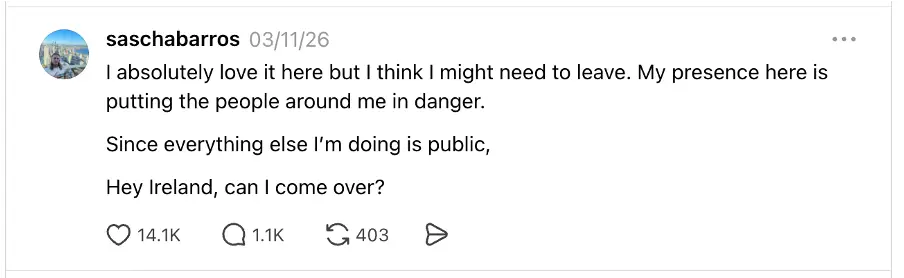
My initial response was ‘Fuck all the way off. We have a crushing housing crisis.’ I’ve been on a mission to inform Americans that Ireland isn’t the escape hatch they think it is and their financial privilege is adding to housing problems here, but I deleted that response because it was rude. I had an extra room. I commented that there is a housing crisis and that I lived alone and had an extra room that he could use if he wanted – no charge. Part of it was about telling his followers that there was a housing crisis, part of it was about being generous. I thought if people saw someone willing to make that offer, they might consider what they could do to help. I did not, in my wildest imagination, think it would turn into anything more than a comment.
One of the first responses was someone from Boston asking if they could have the room. Of course the answer was ‘no,’ but it made me question why I would offer it to Sascha and not anyone else. It bothered me that I couldn’t offer the room to some randomer, but I felt I knew Sascha somehow. I at least knew of Sascha, along with half a million other people. That was the difference. I also felt like I knew the worst about Sascha because he had come forward about being a survivor of trafficking and abuse. My comment got a lot of attention, more than I’d ever gotten on Threads previously and almost all of it was positive. This was fun!
I’ve spent the last 20 years working in online advertising and the last few years specifically in social media marketing. Having to pay for engagement for clients, it was intoxicating to get so much more attention for myself organically. I suddenly knew how homely men that spend a fortune every week for years at strip clubs feel when they go on holiday and are suddenly the man of the hour. I was also working my ass off promoting a short film I’d made of a poem my mom wrote called No Return To Tír na nÓg all that day. It was only a few days before Saint Patrick’s Day, and I was sending out hundreds of emails and posting the video on my socials and YouTube – so the attention from a random comment I’d made on Threads felt like a payoff - even though the two weren’t connected.
After the play, I saw that Sascha replied that he might take me up on the offer – which shocked the hell out of me, but it also played on my ego in a way I hadn’t expected. My ego can be easily ensnared, and it was that evening. Because of all the attention my comment got (1.8K likes in total), Sascha’s response felt public, like in a stadium of two thousand people, he shined a brief spotlight on me.
Irrespective of my excited ego, I took the time to try to fully consider what I would be offering if I followed through. I also knew I could easily let it go and not respond at all. I reminded myself that all those social media people didn’t know me from Adam. They weren’t real to me and I wasn’t real to them. They did not need to be a factor in my decision.
What did need to factor was who I am. I am an idealist; not because I’ve lived a charmed life but because I’ve struggled. I fight for better. I look for subtle glimmers of hope and connection. I try to offer a helping hand. I believe in social justice and that I have to engage and work at it as much as I expect others to as well. If I don’t create the world the way I want it to exist, then what am I striving for? I am concerned about our shared humanity, what it means to act humanely, and to be generous. I try to take care of people when and where I can. I am also flawed and usually aware of my limitations. I considered how I would feel if I didn’t follow through…and this feeling…of dread came up. This feeling that if I turned my back on something I was capable of doing to help, not just for Sascha but for the whole situation then I would lose my integrity. I would lose the part of me that believes that I can effect change for the better – that I can be effective. Because if I had change for the better in my hand, and decided I couldn’t be bothered then I have to accept inaction from everyone else, too.
That was a big, abstract feeling. I thought about the specifics, too. If Sascha was telling the truth and needed a safe place, I could offer one – and if he wasn’t telling the truth, and others needed him removed for their safety, I wouldn’t be putting anyone but myself at risk. And was there really a risk? If he was dangerous, there were thousands on social media that would care, and I could leverage them. That was probably the stupidest thought I had about the whole thing. I also knew that Sascha taking me up on my offer would be completely absurd.
I sent a private message with my email address. He didn’t respond. Honestly, that is what I expected, and I was relieved. I didn’t post about it again. When weeks went by without any follow up from Sascha, I assumed he’d gone in another direction. I had seen some posts about him reaching out to Rosie O’Donnell, who had done a TikTok about Sascha’s Substack interview. That was great news to me because it meant he would get support from someone so much better placed to help than I, and Rosie gave the story clout. I figured that once he was in Ireland with Rosie, I might reach out and see if there was any other way I could help, not just with Sascha but with any part of getting justice for any of the survivors.
Then Sascha contacted me via DM on Threads on 19 March that he would be heading to Ireland in a week and that he’d love to take me up on my offer and I responded that he could.
***
We DM’d sparsely and then exchanged phone numbers. I assumed his lack of engagement was about safety.
I was excited and nervous as Peter drove us to the airport to collect Sascha. I took on board what Peter told me about keeping my finances to myself. Peter has a way of looking out for me that doesn’t diminish my autonomy – no matter how wild or outlandish I am. Peter gives me his point of view, and then moves out of the way so I can make my own decisions. Those decisions include helping someone I’d never met fly back to the Bay Area from Dublin after they had emergency surgery, moving to England for a few months, quitting my job to focus on writing, and almost becoming a member of a cult based on the Hermetic Order of the Golden Dawn to name a few. Peter and I don’t live together, but our choices impact each other, and I hadn’t consulted Peter before offering Sascha the room. We were both dumbfounded by the turn of events that led to Sascha coming to Ireland and taking me up on my offer, but we are also people who believe actions matter a lot more than good intentions.
I was considering every aspect of my decision no matter how good, bad, or awful Sascha turned out to be. I was more realistic than paranoid but there was a part of me that had contemplated a scenario where Sascha’s plane mysteriously crashed. That’s how wildly the situation swirled around my head and how unhinged my thoughts could get. I don’t believe for a second that Virginia Giuffre killed herself any more than I believe Jeffrey Epstein did. It wasn’t beyond the realm of possibility to think something odd might happen.
Sascha arrived in Ireland on 2 April 2026. I was grateful Peter was able to do the pick-up so Sascha wouldn’t have to find his own way to bum fuck nowhere with all his luggage.
Once we met up at the airport, I waited with Sascha while Peter got the car. Sascha immediately started talking about his TikTok video getting over 25 million views and how he was recognised in Toronto Airport. I had no idea what he was talking about. I hadn’t seen or heard about the TikTok video.
The conversation was awkward. He wanted to talk about the TikTok video, I wanted to know if people were looking for him, how safe we needed to be and what precautions might need to be taken. He said he felt safe as soon as he landed and that was the end of that conversation. Sascha said he almost got tripped up with the border patrol because when they asked him how long he planned to stay, Sascha replied, ‘until I have an Irish accent.’ I laughed and said, ‘That might take more than 20 years,’ because I’ve lived in Ireland since 2007 and I still sound like a Yank. Sascha laughed and said they gave him a visa for 12 weeks, and he was going to do his damndest to sound like a native as quickly as possible in his Oklahoma-ish twang.
In a text he sent to me a few days before he arrived, Sascha wrote that of all the countries he’d visited, he liked Ireland the most. On the drive home, he revealed he had only ever been on a stopover in Shannon with the US military decades before. From the sounds of it, I’m not sure he got further than Shannon Airport on that original trip. It made me realise my understanding of ‘visiting’ a country, and Sascha’s were wildly different. It also made me wonder if he would like Ireland. There’s a massive difference between spending a few days at an airport and living here. There are things about life in Ireland, like the weather and the endless damp, that you have to find endearing or you go a bit mad.
Peter asked Sascha questions about being in the military, and Sascha answered. Hearing about Sascha’s military service calmed me. I’m anti-militarisation, but I have good friends who have served in both the US and Irish armed forces, and they are some of the best humans I know. Being anti-aggression, anti-war, and anti-violence does not mean I’m anti military personnel. Knowing Sascha served made him less of a wild card. That might seem counterintuitive to many, but the discipline of military service instils an internal cohesion and sense of order irrespective of external chaos, which I find comforting. At that time, I also assumed that if anyone came at us, Sascha would be able to defend us to a degree. That assumption was ill conceived.
Peter and I chatted away and asked Sascha general questions to get to know a bit about him without alluding to the situation he was in. We wanted him to feel like he could exist without everything being about his circumstances – and we went out of our way to let him know no one in Ireland would know who he is or bother him. Sascha said he liked drinking Irish car bombs, we immediately and vehemently disabused him of ever mentioning that again – ever – anywhere, not just Ireland. He moved the conversation to the millions of views of the TikTok video and being recognised in Toronto again. I told him about Jay-Z and Beyonce being able to walk through Phoenix Park in Dublin without anyone bothering them and Cormac Moore’s now infamous voicemail message to TMZ explaining that the Irish usually have better things to do than harass famous people in parks. My point was, even if anyone in Ireland recognised him – which was unlikely – no one would bother him. It’s just not the Irish way. It didn’t register any response, but Sascha had been travelling for 2 days at that point, and I assumed he was exhausted.
When we got to the house, I showed Sascha to his room. I went with Peter to do a shop, but Peter got a call and had to rush back to work. Picking up Sascha took longer than it should have. I went to the shop to get some bits to have in the house. When I got back, Sascha was unpacking and was already talking about all the changes he wanted to make to the house.
Chapter 3 release date 26 November.
Join The Email List
House of Mirrors is a memoir about the chaos and confrontations that erupted during Sascha Barros Riley's stay in my bungalow in Ireland. I will be releasing a chapter each week. If you would like to receive chapters via email (so you don't have to rely on social media to find them) please join the mailing list.
Type your paragraph here